PRSAR Water Recovery Team
The Water Recovery Team
prsar.org/the-water-recovery-team.html
Peace River K9 Search & Rescue maintains a specialized unit for the recovery of a person lost in water. It is built as a single integrated unit rather than a collection of assets that appear separately — because in water recovery, the order in which capabilities are applied determines how long the operation takes.
How the unit works
A water recovery is fundamentally a problem of reducing area. Open water offers no natural boundaries, and exhaustive search by a diver is not feasible. So each element of the unit exists to hand a smaller area to the next one.
Sonar
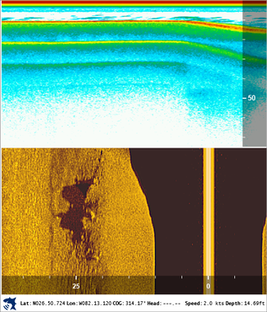
PRSAR uses side-scan sonar to locate underwater targets and perform sonar mapping, and the team is trained in 2D, side-imaging, and down-imaging technologies. Sonar also identifies hazards divers need to avoid — submerged structures, debris, entanglement risk — which matter as much for diver safety as they do for finding the target. Used well, it substantially shortens a recovery.
Certification, and what it does and does not mean
PRSAR drowned victim recovery K9 teams hold certifications from NAPWDA, NNDDA, or NASAR Type II Water, meeting FEMA 508 and applicable ASTM standards. All team members pass a swimmer safety course, Red Cross lifeguard training, and crime scene preservation in a water environment.
We would rather you hear this from us than find it out later. There is no published consensus standard for the detection of human remains in water. ANSI/ASB Std 076-2026, the American National Standard for HRD, is land-only by its own scope clause. The 2009 SWGDOG SC8 guideline covered both land and water, but only the land half was carried forward when the standard was written. A project number for a water standard was reserved in 2018 — BSR/ASB Std 075 — and as of ANSI's August 2026 listing it has still not moved past “new project initiated.”
The certifications above are issued by private organizations to their own criteria. They are worth having; several of them are rigorous, and PRSAR holds them. What none of them is, and what no team can honestly claim for water work today, is certification to a national consensus standard. PRSAR maintains its own written water HRD policy built on that gap, and we have published on why we believe water detection warrants a standard of its own rather than a paragraph inside a land one.
The full picture is on our Cadaver Dogs page.
Working the odor, not the point
Odor in water does not behave the way odor on land does. It moves with the current, surfaces at an offset from the source that varies with depth and flow, and does not sit above the thing that produced it. A K9 indication on the water is an area, not a coordinate, and the most common way these operations go wrong is treating it as a coordinate. Our teams work the indication as a scent field, correlate it with sonar and current, and deploy divers to the resulting target.
Requesting the Water Recovery Team
Call 941-548-7560 or contact us through the form below. There is no cost to the requesting agency.
prsar.org/the-water-recovery-team.html
Peace River K9 Search & Rescue maintains a specialized unit for the recovery of a person lost in water. It is built as a single integrated unit rather than a collection of assets that appear separately — because in water recovery, the order in which capabilities are applied determines how long the operation takes.
How the unit works
A water recovery is fundamentally a problem of reducing area. Open water offers no natural boundaries, and exhaustive search by a diver is not feasible. So each element of the unit exists to hand a smaller area to the next one.
- Sonar maps the bottom and identifies targets and hazards across a broad area.
- K9 teams work from the boat to detect odor rising through the water column and indicate where it is strongest, thereby narrowing the area mapped by sonar.
- Divers go in on a defined target rather than on open water, which shortens bottom time and reduces risk.
- The boat captain holds the search pattern that makes all of the above repeatable and recordable.
Sonar
PRSAR uses side-scan sonar to locate underwater targets and perform sonar mapping, and the team is trained in 2D, side-imaging, and down-imaging technologies. Sonar also identifies hazards divers need to avoid — submerged structures, debris, entanglement risk — which matter as much for diver safety as they do for finding the target. Used well, it substantially shortens a recovery.
Certification, and what it does and does not mean
PRSAR drowned victim recovery K9 teams hold certifications from NAPWDA, NNDDA, or NASAR Type II Water, meeting FEMA 508 and applicable ASTM standards. All team members pass a swimmer safety course, Red Cross lifeguard training, and crime scene preservation in a water environment.
We would rather you hear this from us than find it out later. There is no published consensus standard for the detection of human remains in water. ANSI/ASB Std 076-2026, the American National Standard for HRD, is land-only by its own scope clause. The 2009 SWGDOG SC8 guideline covered both land and water, but only the land half was carried forward when the standard was written. A project number for a water standard was reserved in 2018 — BSR/ASB Std 075 — and as of ANSI's August 2026 listing it has still not moved past “new project initiated.”
The certifications above are issued by private organizations to their own criteria. They are worth having; several of them are rigorous, and PRSAR holds them. What none of them is, and what no team can honestly claim for water work today, is certification to a national consensus standard. PRSAR maintains its own written water HRD policy built on that gap, and we have published on why we believe water detection warrants a standard of its own rather than a paragraph inside a land one.
The full picture is on our Cadaver Dogs page.
Working the odor, not the point
Odor in water does not behave the way odor on land does. It moves with the current, surfaces at an offset from the source that varies with depth and flow, and does not sit above the thing that produced it. A K9 indication on the water is an area, not a coordinate, and the most common way these operations go wrong is treating it as a coordinate. Our teams work the indication as a scent field, correlate it with sonar and current, and deploy divers to the resulting target.
Requesting the Water Recovery Team
Call 941-548-7560 or contact us through the form below. There is no cost to the requesting agency.